
Kona has a reputation that runs ahead of the facts. It is "the hardest one-day race in the world", the place where champions break. Some of that is myth. Some of it is measurable. Here is what the 2026 numbers say, where the history fits, and the two separate controversies that shaped this year's race.
The 2026 numbers
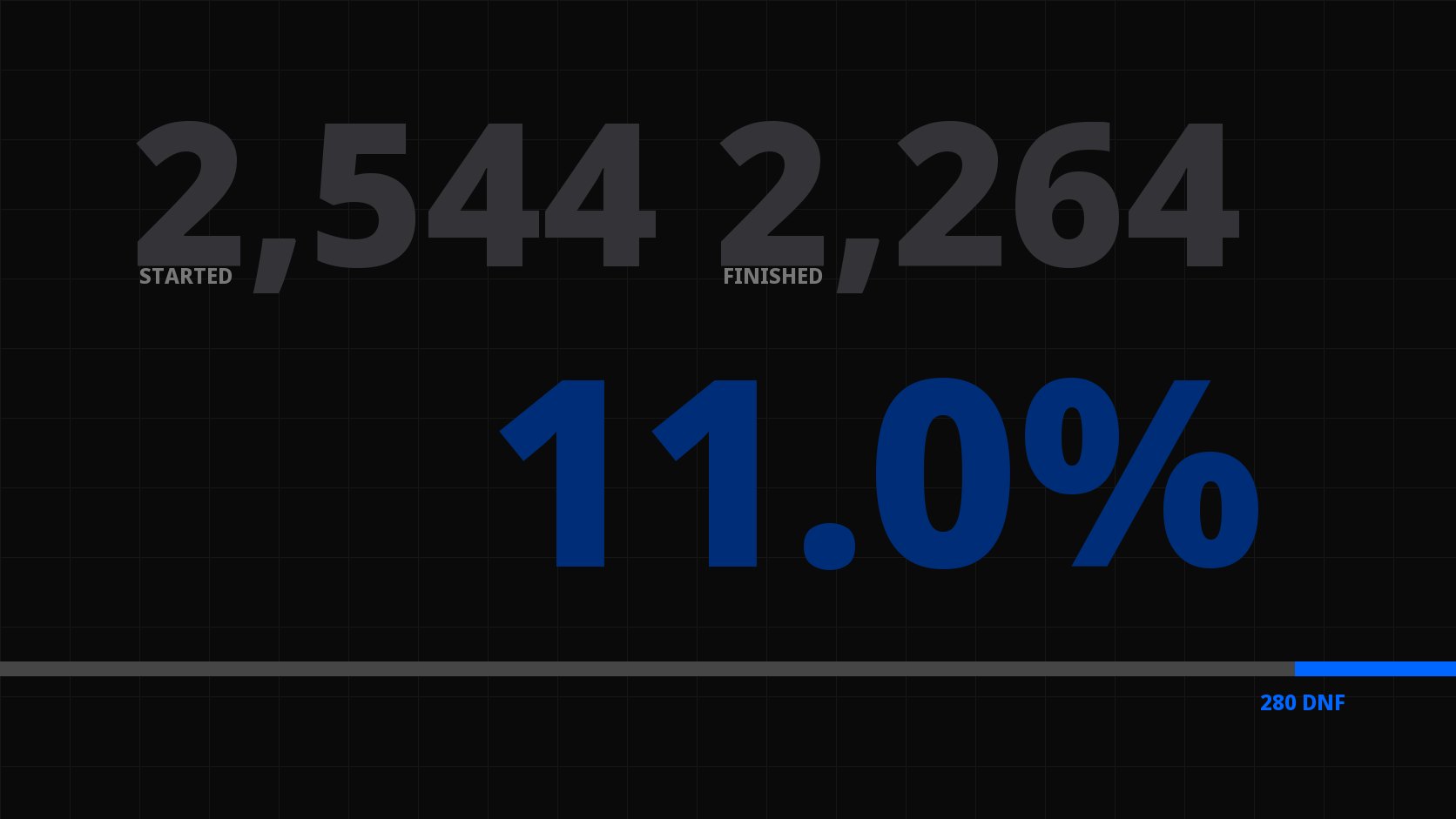
An unofficial results tracker, UNPACE.cc, reports that 2,544 athletes started the 2026 IRONMAN World Championship on 10 October and 2,264 finished, with a median finish time of 11:03:11 (UNPACE). That leaves 280 starters who did not finish, a DNF rate of about 11.0%.
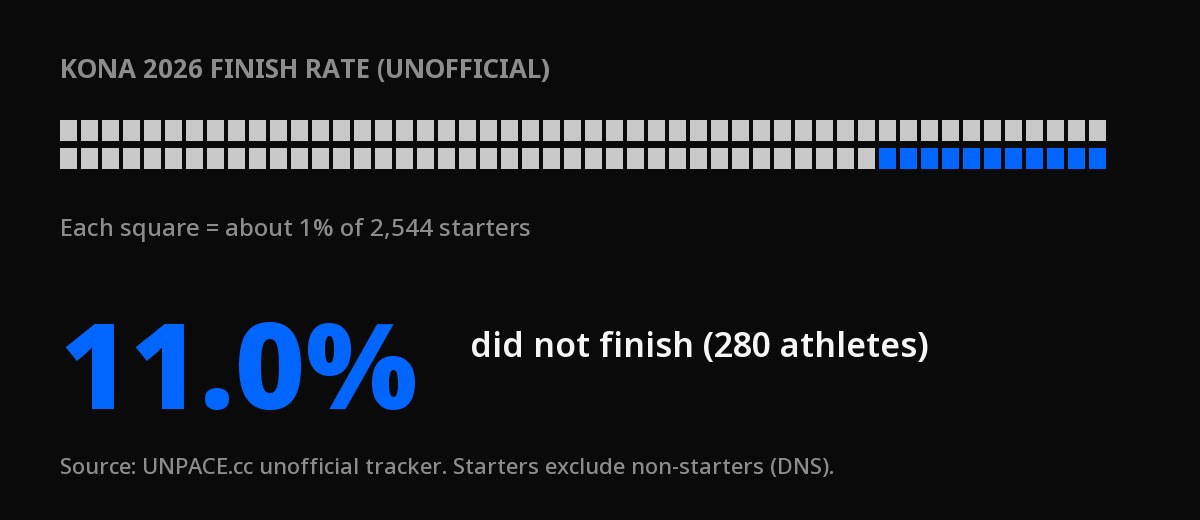
Treat those figures as provisional. The tracker states it will be replaced with official results once IRONMAN publishes them. The count also excludes athletes listed as non-starters, and at the time of writing the tracker classed several professionals who stopped mid-race in its DNS list rather than as DNFs. Until official results are final, 11% is a reasonable estimate, not a settled number.
Is 11% high? It depends what you compare it with, and that is where many articles go wrong. Year-on-year comparisons only work when each year counts starters and finishers the same way. We have not found a consistent, verified multi-year series for Kona, so we are not publishing a historical table. Anyone quoting a precise "worst DNF rate in history" should be able to show the same definitions for every year.
What made 2026 hard on the day
Kona is hard because the conditions stack. A non-wetsuit ocean swim, a bike leg exposed to the trade winds on the Queen K and the climb to Hawi, and a marathon through lava fields and the Energy Lab, usually in heat and humidity.
In 2026 the wind was the headline. Triathlete described historically slow bike times, well off the record pace of recent editions (Triathlete). Longer on the bike means more time exposed, more fluid and carbohydrate to manage, and more fatigue carried into the run.
The professional races showed the cost. Patrick Lange and Jamie Riddle stopped on the bike. Sam Laidlow withdrew early on the run. Lucy Charles-Barclay withdrew during the marathon. Race leader Magnus Ditlev was stopping and staggering on the Queen K before mile 20 when Vincent Luis passed him.
The most dramatic moment was not a DNF at all. Defending champion Solveig Løvseth led the women's race with less than a mile to go, fell, then got up and walked to the finish to place eighth. Taylor Knibb, who had been vomiting and walking earlier in the run, passed her to win (NBC Sports). The sources do not give medical reasons for individual withdrawals or collapses, so we do not offer any.
Read the full race story in Kona 2026: the World Championship that broke the favourites.
A short history of Kona humbling the best
Kona's reputation was built by great athletes failing as often as winning. Mark Allen is the classic example. He did not finish on his first attempt in 1982, and lost to Dave Scott repeatedly through the 1980s, before finally beating Scott in their famous 1989 "Iron War" duel. He went on to win six titles. The lesson people take from Allen is not talent. It is that Kona rewards athletes who learn the island.
Conditions have always varied. Some years the wind is gentle and records fall; other years the heat and wind make everyone slower. That variability is one reason course records and finish rates are poor guides to how "hard" a given year was.
The format has changed too. In 2023 IRONMAN split the championship, with the women racing in Kona and the men in Nice, France. The locations alternated through 2025. For 2026 IRONMAN returned both the men's and women's races to Kona on a single day, the first time since 2019. For more background, see why Kona became the most famous race in triathlon.
Two controversies, and why they are different
It helps to separate what happened on the road from what happened before anyone got there.
Race-day controversy is about what athletes experienced on 10 October: brutal conditions, a high-profile list of withdrawals, a three-minute drafting penalty for runner-up Gustav Iden, and the images of Løvseth's collapse. These raise fair questions about heat, pacing and athlete welfare, but they are questions about one race.
Qualification controversy is structural. For 2026, IRONMAN introduced a new age-group qualifying system that awarded some slots through a gender-neutral performance pool. Triathlete reported that, under the original process, 96% of roll-down slots went to men (Triathlete). After strong criticism, IRONMAN revised the system in November 2025, introducing gender-specific roll-downs and separate performance pools based on participation, and adjusted slots retrospectively. IRONMAN's own announcement is mirrored on PublicNow.
The debate was genuine on both sides. Supporters of the original model argued that performance-based slots reward the fastest athletes relative to their age group. Critics argued that a pool which in practice sent almost all slots to men undermined a world championship that had promised equal opportunity, and that fewer women qualifying would discourage women from racing at all. IRONMAN's revision accepted that the outcome needed fixing. Whether the new pools get the balance right will only be clear over several qualifying seasons.
If you are chasing a slot, our guide on how to qualify for Kona explains the current route.
What this means for your race
Kona's numbers are a reminder that finishing is never guaranteed, even for the best in the world. The habits that help are not secrets:
- Respect the conditions, not the plan. If it is windier or hotter than expected, lower your targets early. A slower bike that leaves you able to run is faster overall.
- Train in the heat you will race in. Heat acclimation takes repeated exposure over days to weeks. Combine it with a measured sweat rate so your fluid and sodium plan fits your body.
- Fuel on the bike, consistently. Carbohydrate is easier to absorb while riding than running. Practise your hourly target in long sessions until your gut tolerates it. Our article on carbs per hour for an Ironman sets out the ranges and how to build up.
- Rehearse the bad patch. Knibb's win came from slowing down and taking care of herself, not from pushing harder. Decide in training what you will do when things go wrong.
- Know what a DNF means for you. Stopping is sometimes the right call. Know the warning signs, use the medical teams, and never let a finish line outrank your safety.
For a full race-day structure, see our Ironman nutrition guide or build an hour-by-hour plan with the free race fuel plan builder. None of these tools can guarantee a finish. They help you arrive with a plan you have tested.
Sources
- UNPACE.cc, IRONMAN World Championship Kona 2026 (unofficial results): https://unpace.cc/en/race/ironman-world-championship-kona/2026
- Triathlete, 2026 Ironman World Championship updates and results: https://www.triathlete.com/culture/news/2026-ironman-world-championship-kona-results/
- Triathlete, Ironman acts on Kona qualifying backlash with rules revision: https://www.triathlete.com/culture/news/ironman-updates-kona-qualification-rules/
- IRONMAN statement (mirror): https://www.publicnow.com/view/3F157C29C5A8FC212E6E379B0F403C4E14F6BF8A
- NBC Sports, Ironman Kona results 2026: https://www.nbcsports.com/olympics/news/ironman-kona-2026-world-championship-taylor-knibb-vincent-luis
- USA Triathlon, Taylor Knibb claims first IRONMAN World Championship title: https://www.usatriathlon.org/news/2026/october/11/taylor-knibb-claims-first-ironman-world-championship-title-in-dramatic-kona-finish
Important information
2026 starter, finisher and DNF figures are unofficial and may change when IRONMAN publishes final results. This article is general information, not medical advice. HYDRAX is not affiliated with IRONMAN.
Quick answers
What was the DNF rate at Kona 2026?
About 11.0%, based on the unofficial UNPACE.cc tracker: 2,544 starters and 2,264 finishers, leaving 280 who did not finish. The figure may change when IRONMAN publishes official results.
Is Kona the hardest Ironman?
It is among the most demanding because heat, humidity, wind and a non-wetsuit ocean swim combine. How hard a given year is depends heavily on the conditions on the day.
What was the Kona 2026 qualification controversy?
Under IRONMAN's original 2026 system, Triathlete reported 96% of roll-down slots went to men. In November 2025 IRONMAN introduced gender-specific roll-downs and separate performance pools and adjusted slots retrospectively.
Did Mark Allen finish his first Kona?
No. Mark Allen did not finish his first Kona in 1982 and won his first title in 1989, going on to win six.